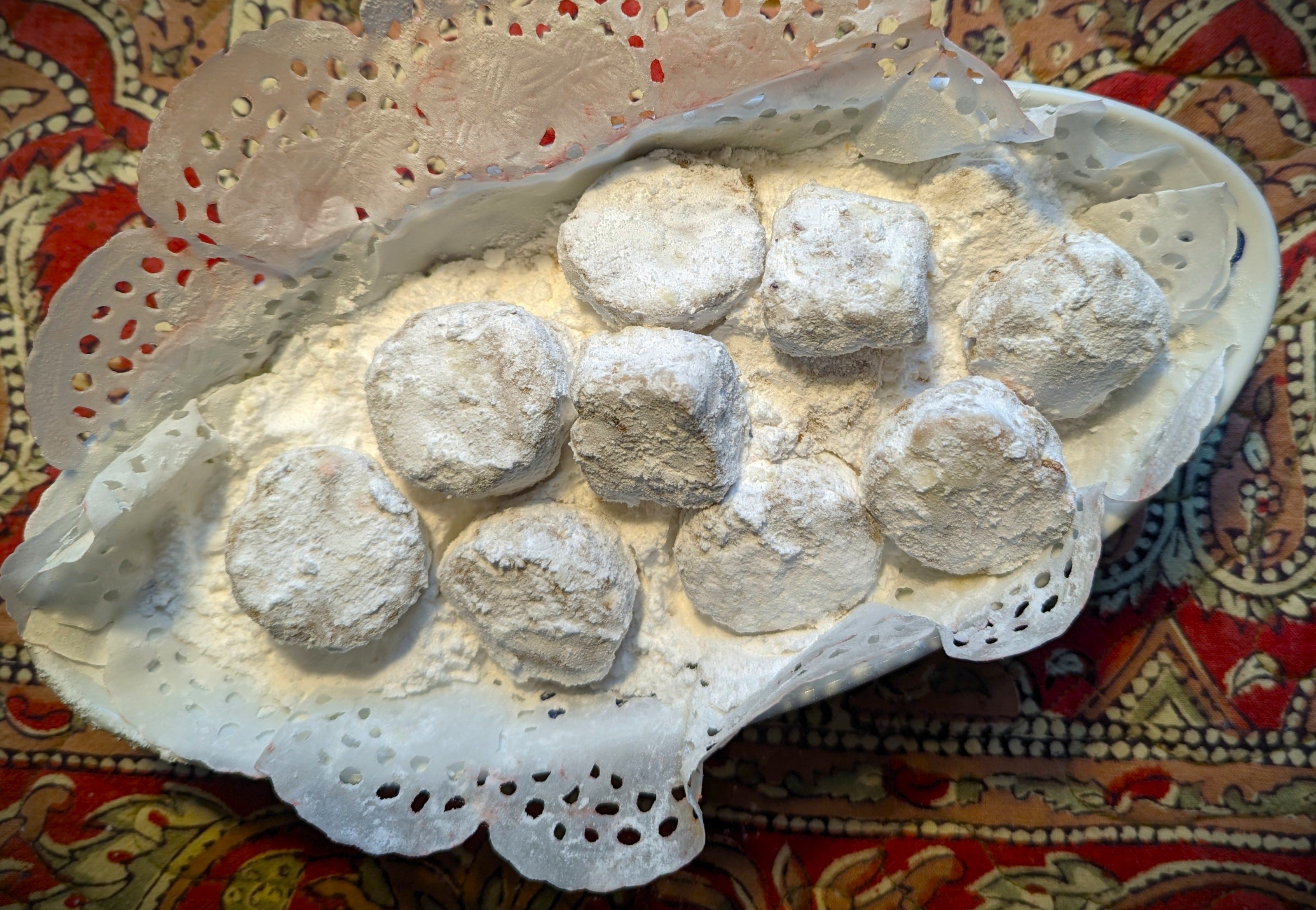
My 99-year old aunt Frosso bakes every year fragrant heirloom kourambiedes from a 200-year old recipe, very different from the cookies found in homes and bakeries. See also my Cycladic version below.
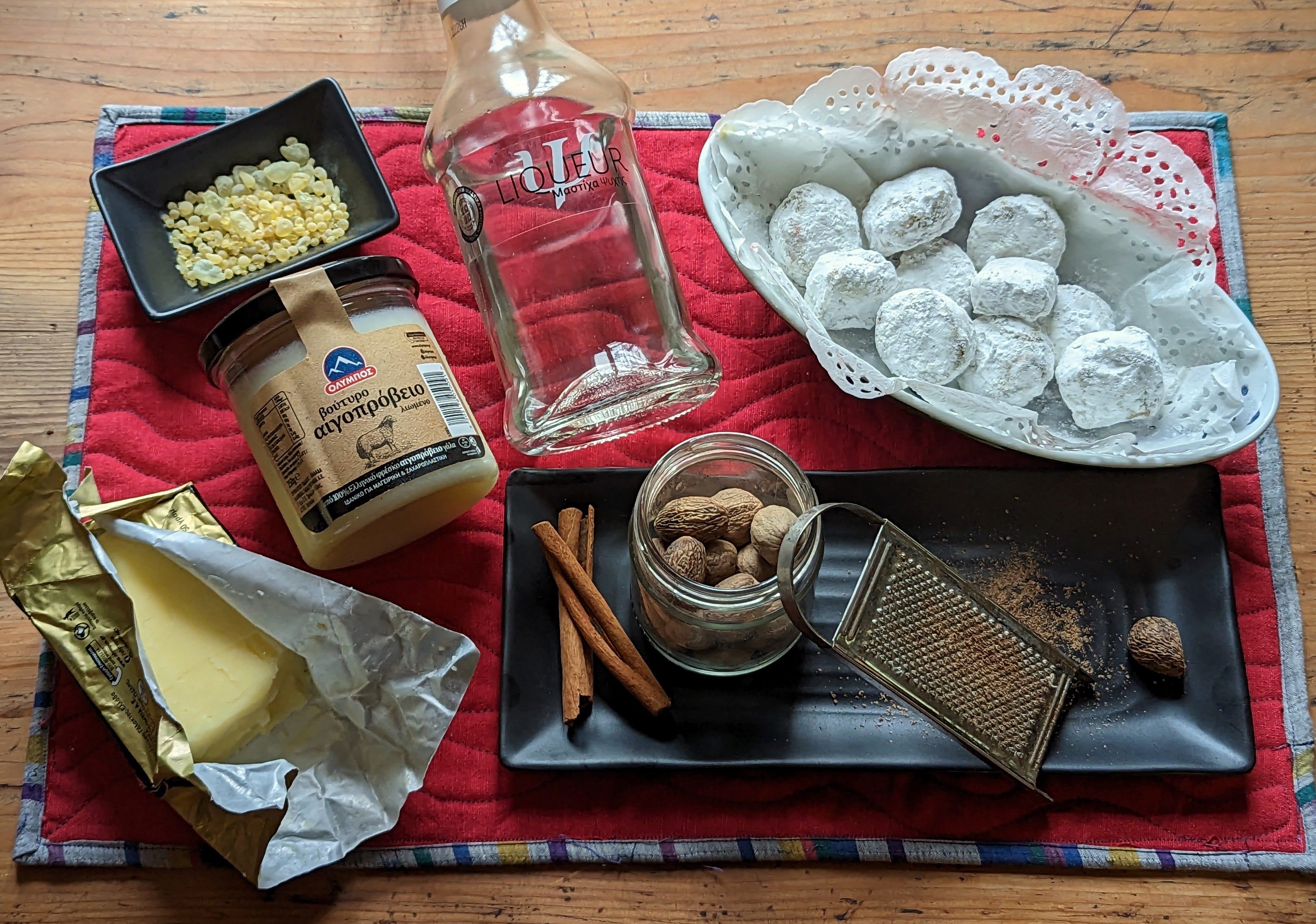
Mastic, both tears as well as liqueur, cinnamon and plenty of nutmeg, along with two kinds of butter: ‘European’ cow’s milk butter, and also the rich, old-fashioned sheep’s milk, often called ‘the good butter,’ seldom used these days.
Frosso Patiniotis, my very lively 99-year old aunt bakes every year these quite unusual, fragrant kourambiedes –shortbread-almond cookies– a few weeks before Christmas.
She shared with me a recipe that Mrs. Dandoura, the mother of her late classmate and closest friend Chrysouli, had originally taught her many years earlier. Mrs. Dandoura’s kourambiedes-making expertise came from her mother and grandmother.
They belonged to a wealthy shipping family from Galaxidi, a town situated 15 kilometers southwest of Delphi. Galaxidi experienced significant growth in the 18th and 19th centuries, flourishing due to its excellent natural port which facilitated maritime trade and commercial interactions with the West.
Calculating the generations that baked these festive cookies, we concluded that the recipe must be at least 200 years old. Thus kourambiedes were not, as the Greek version of Wikipedia cites “brought by prosfyges (refugees),” the Anatolian Greek population who fled after the defeat in the Greco-Turkish War (1919–1922) from Smyrna (Izmir) and other parts of Turkey.
Prosfyges did, indeed, introduce quite a few special foods to Palaioelladites —the local Greeks– but certainly kourambiedes were already part of the local festive table in many parts of the country.
The word kourabies (plural kourabiedes) derives from Qurabiya a Persian and/or Arabic word with many variations, which is used for short-bread cookies throughout the Eastern Mediterranean and North Africa. These cookies are usually scented with rose or citrus-flower water. But I had not seen versions of kourambiedes with so many spices.
My assumption is that the cosmopolitan Galaxidi merchants were maybe inspired by the festive European/Grerman Christmas cookies. But this is my hypothesis, as I consider baking Pfeffernüsse and Lebkuchenthese days…
Wedding Treats
Paula Wolfert in her wonderful 1988 book ‘Paula Wolfert’s World of Food‘ has a version of kourabiedes she calls ‘Greek Butter-Almond Cookies’ and over the years she kept telling me how amazing they were. As she wrote in the headnote of her recipe she served them at her wedding, as some Greek families do.
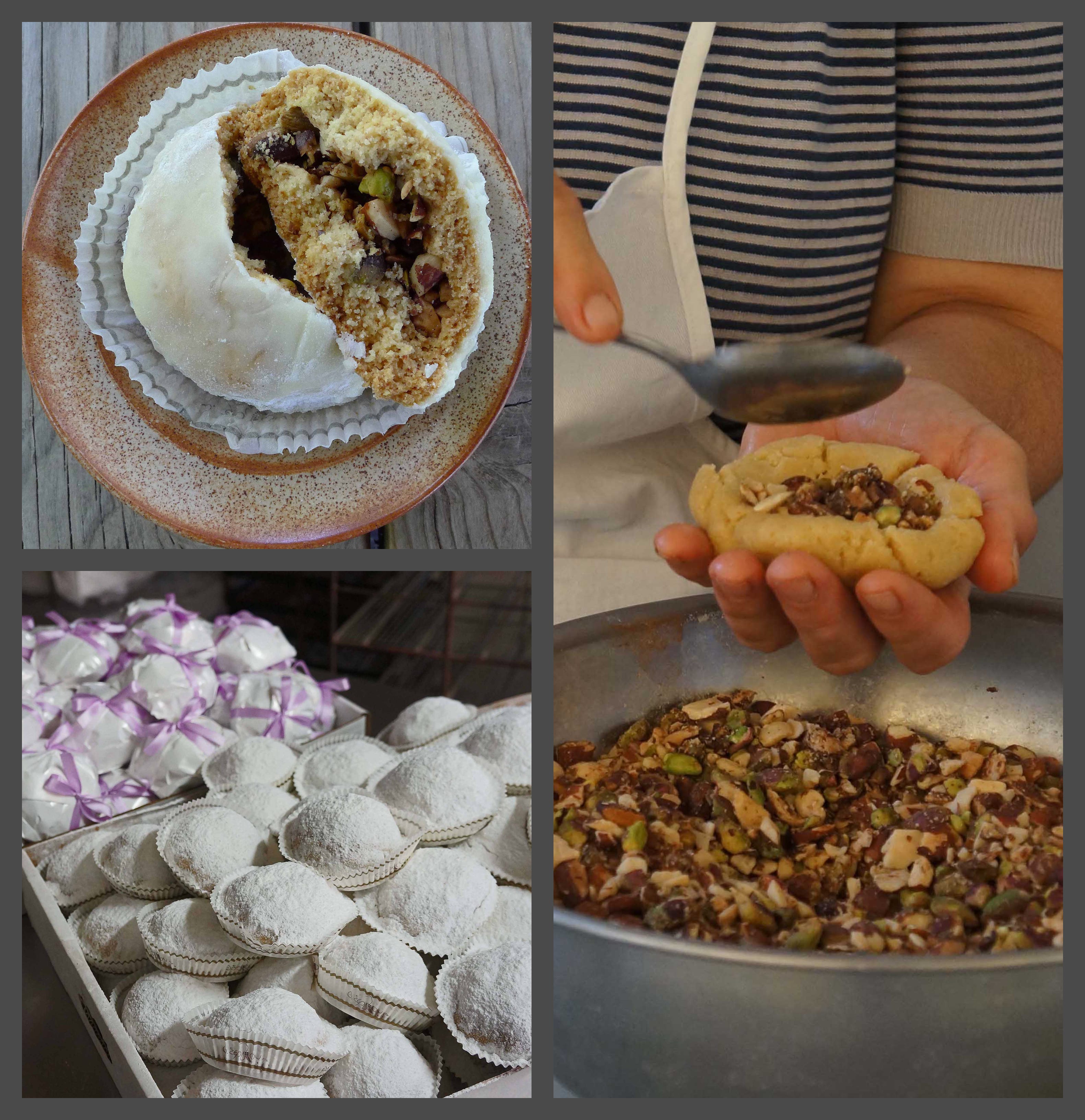
In Cyprus similar large butter cookies stuffed with nuts and candied fruit are traditionally offered during weddings.
But they are called loukoumi and not kourambie(!) one more example of the confusion between the names of many dishes throughout the Eastern Mediterranean.
In a food processor or electric mixer, beat the butter for about 6 minutes until very light and fluffy. Gradually add the sugar and the the egg yolk, and continue beating, then add the liqueur or ouzo and process for 2-3 minutes more.
Sift the flour with the baking powder, and the spices.
Fit the processor with a dough hook and gradually add the flour. Process the mixture for just a couple of minutes, until a soft dough forms. Add the almonds and process until the dough is smooth again, about 1 minutes more.
Preheat the oven to 350º F (180º C).
Shape tablespoons of dough into round, oval, or crescent-shaped cookies, and place on a cookie sheet, leaving about 1 inch between the cookies so that they won’t stick together as they expand.
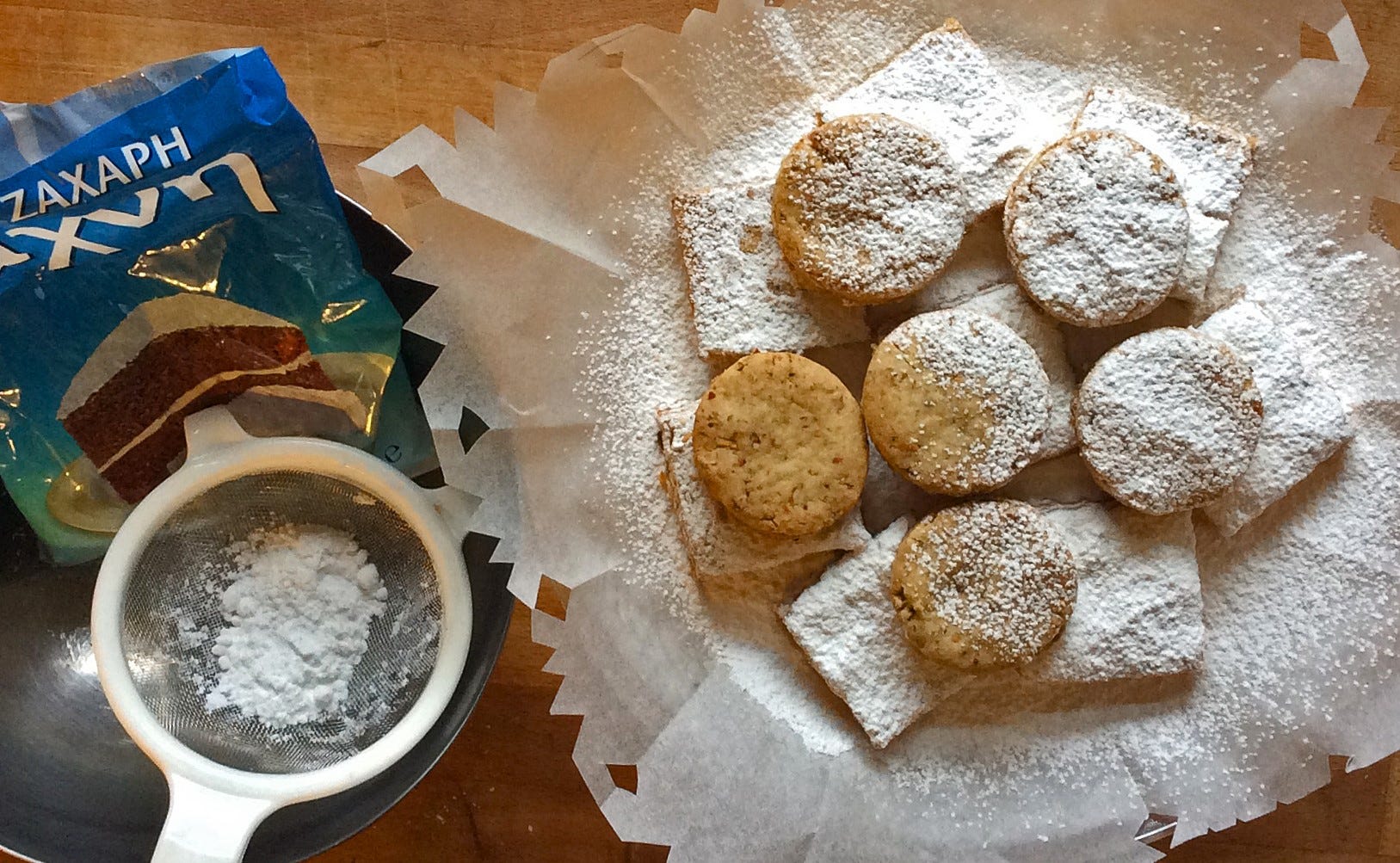
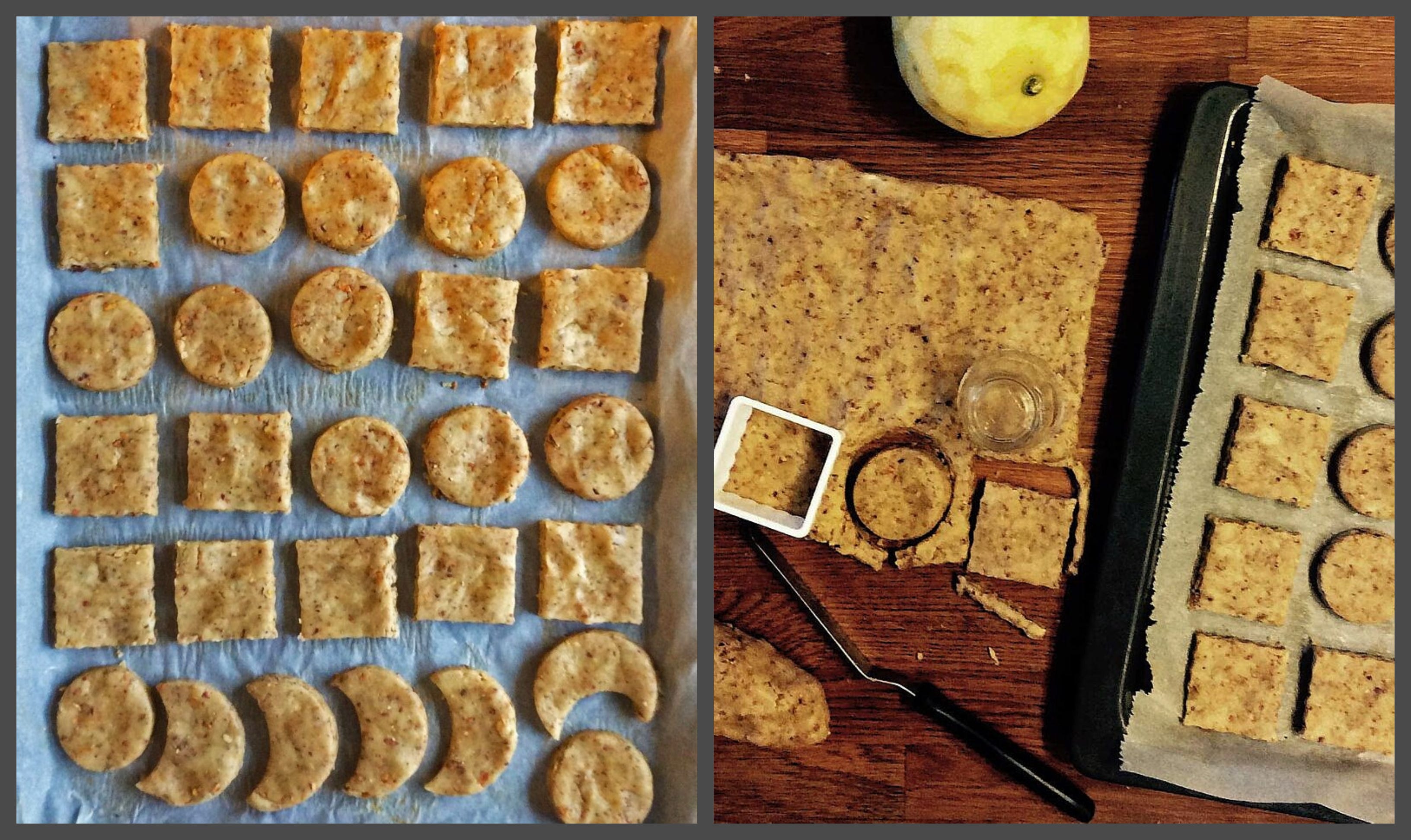
Alternatively flatten the dough on the work surface making about 1/3 inch thick squares, and with small cookie cutters cut rounds, squares or crescents. Collect and flatten the leftover dough, then cut into shapes again.
Bake for about 25 minutes, until pale golden. Cool for 5 minutes then sprinkle with the flower water.
Spread 2 cups confectioners’ sugar on a large serving plate. Very carefully, because they break easily, roll each cookie in the sugar, and place on a rack to cool.
Proceed with all the cookies, adding more sugar to the plate as necessary
Cycladic Island Kourambiedes
The old island recipes called for lard, as butter was not a common ingredient on the Cyclades, while the special fat from the belly of the slaughtered pork was used for these, and other festive winter sweets .
In most recipes from the mainland and the north, kourambiedes are still made with the strongly-flavored sheep’s milk butter, while there are also also some Lenten versions made with olive oil.
Today most homes and bakeries prepare the cookies exclusively with regular cow’s butter, or a combination of butter, often with some sheep’s milk butter.
I do love this old, Cycladic version which you could try if you can get good lard.
I like to shape very small cookies as it is very difficult to eat just one…
Makes about 30 large or 40 small cookies.
1/2 cup lard or butter, softened
1/2 cup light, mellow olive oil (not fruity)
1/3 cup confectioners’ sugar, plus about 2 cups to sprinkle on the cookies
1 egg yolk
Zest of 1 large lemon
3 tablespoons ouzo, Pernod, or any other anise-flavored liqueur
3 cups unbleached cake or all-purpose flour
1 ½ teaspoon baking powder
½ teaspoon ground white pepper (optional)
1/2 teaspoon salt
1 cup coarsely ground toasted almonds (not skinned)
In a food processor or electric mixer, beat the lard or butter and olive oil with 1/3 cup confectioners’ sugar for about 6 minutes. Add the egg yolk, lemon zest, and ouzo and process for 2-3 minutes more. Sift the flour with the baking powder and the pepper, if using. Fit the processor with a dough hook and gradually add the flour. Process the mixture for 2-3 minutes, until a soft dough forms. Add the almonds and process until the dough is smooth again, about 1-2 minutes more.
Preheat the oven to 350º F (180º C).
Shape tablespoons of dough into round, oval, or crescent-shaped cookies, and place on a cookie sheet, leaving about 1 inch between the cookies so that they won’t stick together as they expand.
Alternatively flatten the dough on the work surface making a square about 1/4 inch thick, and with small cookie cutters cut rounds, squares or crescents. Collect and flatten the leftover dough, then cut into shapes.
Bake for about 25 minutes, until pale golden, depending on their size. Cool for 10 minutes.
Spread 1 cup confectioners’ sugar on a large serving plate. Very carefully, because the cookies break easily, roll each one in the sugar, and place on a rack to cool. Proceed with all the cookies, adding more sugar to the plate as necessary.
Finally, sift additional sugar on top of the cookies and let rest for 3 to 4 hours or overnight. Carefully pack the cookies in boxes, spreading a piece of waxed paper between each layer.
Toasted Almond Cookies will keep in an airtight jar for 2 months or longer.
Aglaia & Costas' Aegean Island Kitchen is a reader-supported publication. To receive new posts and support my work, consider becoming a free or paid subscriber.
Aglaia, i was happy to see this post (as i am with all your posts) because id just been engaged with a FB friend in a conversation about Kourambiedes. My recipe is not quite so ancient as yours but it goes back to the 1960s and Craig Claiborne’s New York Times cookbook. I made them diligently for many years but somehow after the children grew up and before the grandchildren arrived, they fell off my radar. You’ve inspired me to resurrect them. Thank you!

For people who have no idea how to measure a cup of butter I got Chatcpt to convert this to a British recipe: (hope that's ok?)
Greek Almond Biscuits (Kourabiedes – UK Style)
Ingredients
300 g unsalted butter, very soft
(ideally sheep’s milk butter if available)
30 g icing sugar, plus 250–300 g icing sugar for coating
1 egg yolk
2 tbsp ouzo or brandy
(brandy is more traditional for kourabiedes)
150 g whole almonds, skins on, lightly toasted and coarsely chopped
300–340 g plain flour
1¼ tsp baking powder
Method
Whip the butter
Beat the butter for 6–8 minutes using an electric mixer until extremely pale, fluffy, and mousse-like. This step is essential for authentic texture.
Sweeten & enrich
Gradually add the 30 g icing sugar, beating well.
Beat in the egg yolk, then the ouzo or brandy, mixing until fully incorporated.
Add dry ingredients
Sift together flour, baking powder, cinnamon, and nutmeg.
Add to the butter mixture in 2–3 batches, mixing gently on low speed or folding by hand.
Stop as soon as a soft, non-sticky dough forms.
Fold in almonds
Gently fold in the toasted almonds by hand. The dough should be tender and delicate, not elastic.
Shape
Preheat the oven to 180°C (160°C fan).
Shape tablespoons of dough into balls, ovals, or crescents, or roll out to 8 mm thick and cut with small cutters.
Place on lined trays, leaving 2–3 cm between biscuits.
Bake
Bake for 20–25 minutes, until the bases are just turning golden but the tops remain pale.
Scent
Allow to cool for 5 minutes, then lightly sprinkle with rose water or orange blossom water.
Sugar coat
Spread icing sugar onto a large plate.
While still slightly warm, very gently roll the biscuits in icing sugar.
Transfer to a rack and, once fully cool, dust again for the classic thick white coating.
Aglaia, i was happy to see this post (as i am with all your posts) because id just been engaged with a FB friend in a conversation about Kourambiedes. My recipe is not quite so ancient as yours but it goes back to the 1960s and Craig Claiborne’s New York Times cookbook. I made them diligently for many years but somehow after the children grew up and before the grandchildren arrived, they fell off my radar. You’ve inspired me to resurrect them. Thank you!