
…but this time it is Costas, Aglaia’s husband writing. I am reaching out to thank you all for your warm goodbye letters and commemorations of my wife’s life (see links below).
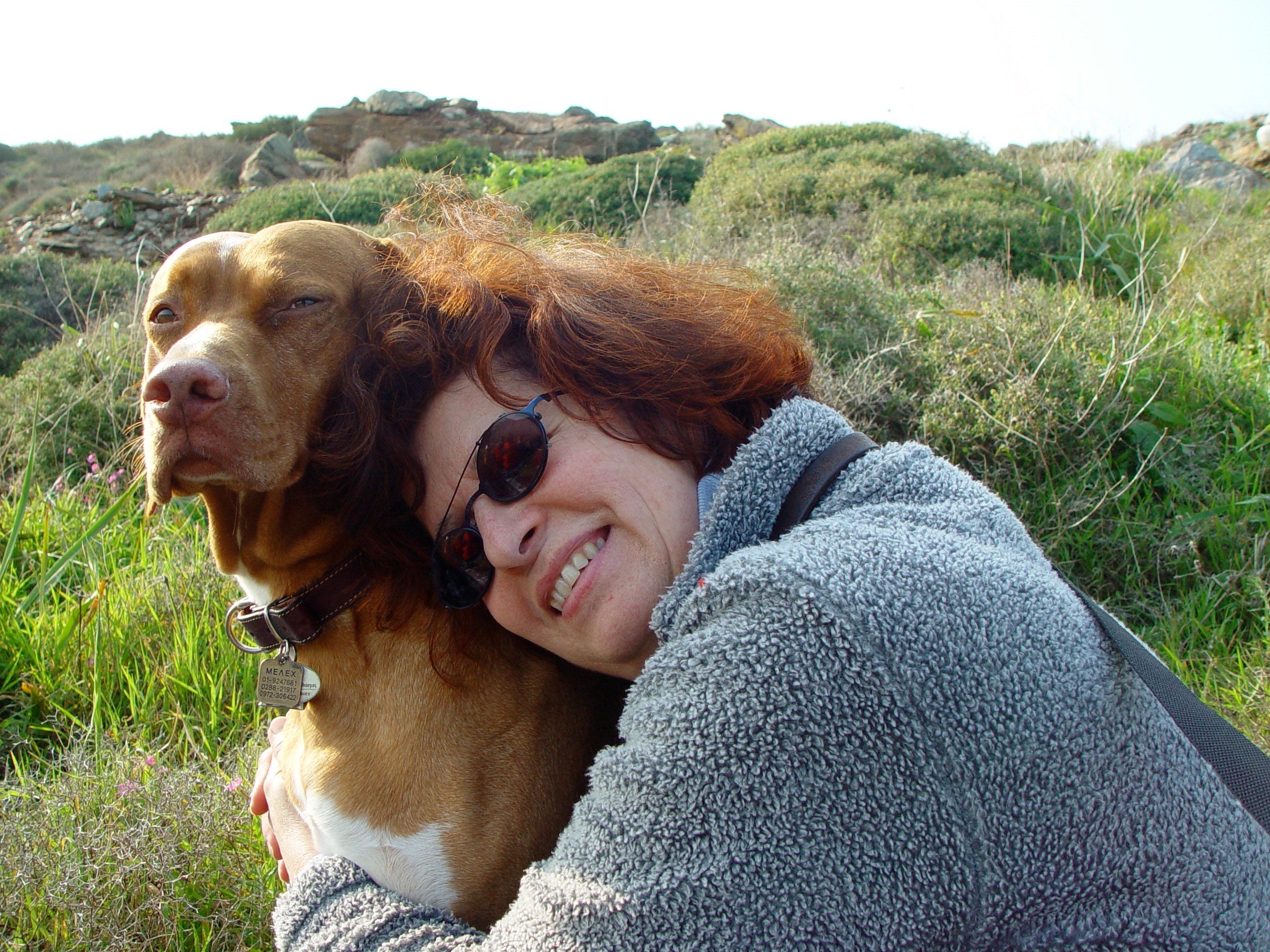
Aglaia passed away on May 18. She had suffered for more than a year with unbearable pain from secondary bone cancer. She was very brave and never complained. I miss her terribly.
I was left alone with our dog Neva; and as if Aglaia’s passing was not enough, just two weeks later I lost Neva too. She died quickly, in just a few hours, from internal hemorrhage due to a tumor. The night before she was as playful and hungry as ever.


Aglaia and Neva were inseparable, and would take long morning walks by the seaside. I was waiting for them back home for breakfast. But no more.
*****
The title to this newsletter comes from Leonard Bernstein’s musical On The Town. It is from the song “Some Other Time,” that we played during Aglaia’s cremation ceremony. We both loved this song.
*****
I am not sure I will continue Aglaia’s newsletters. I do not come from the world of food, even though I learned a lot after 30 years of marriage with her. I think this will probably be the last newsletter, a big thank you all for making Aglaia part of your reading habits.
…and maybe we’ll catch up some other time.
Costas-
*****
Quite a few people wrote about Aglaia’s life and work, among whom Sara Baer-Sinnott, Corby Kummer, José Andrés, Fred Plotkin, Ellen Kanner, Greg Patent.
*****
Here below is the contribution Aglaia’s niece Frosyni Charitopoulou read at the farewell ceremony. I think it describes my wife and our relationship quite accurately:
“If I had to use one term, I would say that Aglaia was a true “hipster”: a person who followed alternative trends. She naturally chose what was different, what was alternative — and when, years later, that became mainstream, she had already moved on to the next thing.
And within this there was something very characteristic of her: her adaptability to very different situations and, even more so, the ease with which she made them her own. In New York and Oxford, in the “international” circles to which she so much enjoyed belonging. In Tzia, in nature, taking walks with Neva. In her kitchen, cooking and having many people gathered around her table. Writing. She was multifaceted and constantly evolving — and all these dimensions of her always seemed entirely her own, entirely familiar.
Aglaia was someone who helped those close to her in a meaningful way. I think that, perhaps because there was often a certain anxiety behind her decisions and reactions, this help, this care, could at first glance — at least that is how I sometimes felt it — seem like pressure. But once you moved beyond that first, superficial reading, you understood that her attitude came from the fact that she truly cared. And she wanted to help. To make you see something that she herself could see.
Aglaia, as Kostas recently pointed out to me, could say something that, if someone else had said it, might have had real consequences. But because her manner was so natural, so genuine, she somehow managed not to be treated that way.
And I remembered one time when she had come to pick me up from the port in Tzia. It was summer, with many cars, people coming and going. Suddenly Aglaia sees that, on the opposite side of the road, the greengrocer is selling figs — and she wanted to make that incredible fig bread she used to make. She drives straight across the road, leaves the car with the hazard lights on, and goes to choose her figs.
And then the port policeman comes over and, obviously, reprimands her — quite sharply. And instead of apologizing, Aglaia began talking about all the tourists who come and make it impossible for the residents to live, with their cars and all the problems they create. And the port policeman simply left.
Aglaia and Kostas – a couple with whom I always had such a lovely time whenever I visited them in Tzia. I was always struck by how each of them knew about the other’s life before they were together, as if they had already been there. Kostas knew and would tell stories from Aglaia’s past, from her “childhood years,” as though he had lived them with her too. A couple who truly communicated. A couple who, after so many years, still laughed with one another. Even at the difficult end, in the hospital. But above all, a couple who truly cared for one another.”
oooh, Costas! It is so sad to hear this news. I always looked forward to meeting Aglaia at the Oxford Food Symposium. Her deep knowledge, her eagerness to share that knowledge, and her collaborative way of working with everyone was a joy to behold and experience. She will be missed, worldwide, but especially on your island.
Ar dheis Dé go raibh a hanam dílis (May her faithful soul be on the right hand of God)
With deep sympathy and sincere condolences,
John Mulcahy, Ireland.
Costas - my thoughts and feelings have been with you these last weeks. The time I spent in Kea is a cherished memory that resurfaces often. Thank you. You’re both in my heart.